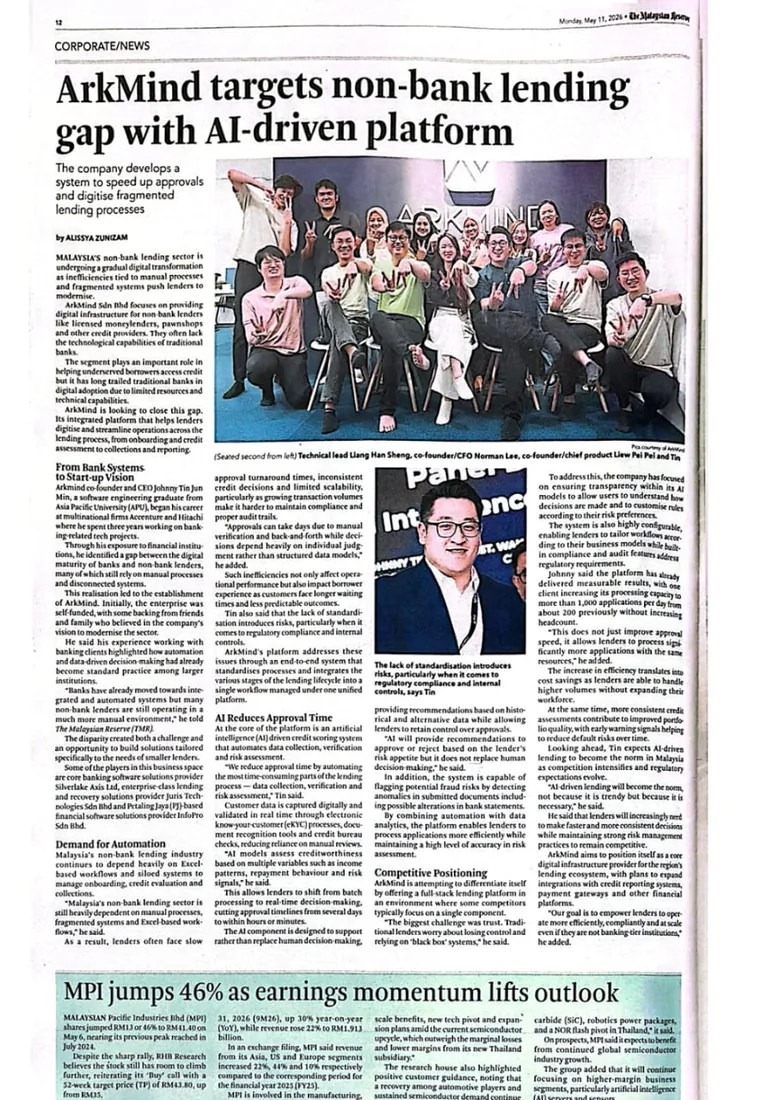
Arkmind was featured in The Malaysian Reserve for modernising loan origination in Malaysia, from onboarding to AI-assisted credit decisions on one platform.
Most lenders in Malaysia still run origination on spreadsheets and disconnected tools. An application arrives by email. The credit check sits in one system, the approval in another, and collection in a third. Loan origination in Malaysia carries a hidden tax: every handoff is manual, slow, and hard to audit.
Arkmind builds loan origination and management software for Malaysian financial institutions. The Malaysian Reserve featured our work helping lenders modernise how they originate and manage loans, from customer onboarding and credit evaluation through to collection.
This article explains what modernising loan origination looks like in practice, where legacy setups break, and what changes when the full loan lifecycle runs on one platform.
What you will find below:
- What modernising loan origination in Malaysia involves
- The points where spreadsheets and legacy systems fail lenders
- How one platform handles onboarding, credit evaluation, and collection
- Where AI fits, from ArkGPT to the Credit Engine
- Why a homegrown, KPKT-ready partner shortens the path to go-live
What does modernising loan origination in Malaysia mean?
Modernising loan origination means moving the full loan lifecycle onto one digital platform. A borrower applies, gets verified, is scored, and is approved inside a single system. The same platform then handles disbursement, repayment, and collection, so no step depends on a spreadsheet or a manual handoff.
The shift is structural, not cosmetic. A digital portal on top of the same fragmented back office still leaves staff re-keying data and chasing approvals. Real modernisation connects every stage, so the data a borrower enters once flows through onboarding, the credit decision, the loan book, and the collection queue without a human copying it between tools.
Where legacy systems and spreadsheets break down
Spreadsheet-driven lending works at low volume. It stops working the moment a lender grows or a regulator asks for an audit trail. The failure shows up in four places:
- No single view of the borrower. Application, credit, and repayment data live in separate files, so no one sees the whole relationship.
- Manual re-keying introduces errors. Each copy between systems is a chance to transpose a number or drop a field.
- Slow approvals lose customers. A decision held up by email and manual checks pushes the borrower to a faster competitor.
- Compliance is hard to prove. Reconstructing who approved what, and when, takes days when the record is scattered across files.
Credit evaluation suffers most. A scorecard is only as good as the data feeding it, and fragmented inputs produce decisions a lender cannot defend later.
What a banking-grade platform changes
A banking-grade platform replaces the patchwork with a single system for the whole loan lifecycle. Three stages do the heavy lifting.
Digital onboarding moves identity checks online. Electronic Know Your Customer (eKYC) verifies an applicant in minutes instead of asking them to visit a branch. The borrower self-manages the application, and the lender receives clean, structured data from the first step.
Credit evaluation runs against a consistent scorecard. Every applicant is assessed on the same inputs and rules, so decisions are faster and easier to audit. The credit team reviews exceptions instead of re-entering data.
Loan management and collection sit on the same record. Disbursement, repayment schedules, and overdue accounts update in one place. Collection teams work from a live view rather than a stale export. Our digital lending solutions connect these stages so the loan book reflects reality at all times.
How AI is changing credit evaluation
The next gain in loan origination comes from the credit decision itself. A scorecard applies fixed rules. An AI model reads more signals, weighs them against real repayment outcomes, and flags risk a static rule misses. The result is a sharper decision on each application, made in seconds.
Arkmind is building two tools in this direction. ArkGPT brings a language model to the parts of lending involving documents and questions, from reading a payslip to answering a borrower in plain language. The Credit Engine focuses on the appraisal itself, scoring an applicant on richer data so a lender lends with more confidence and fewer defaults.
These tools sit on the same platform as onboarding, the loan book, and collection. This matters, because an AI model is only as good as the data it sees. A connected platform feeds the model clean, current information from every stage of the loan, rather than a stale export. As the model learns from real outcomes, each credit decision improves on the last.
Why a homegrown partner matters for KPKT-licensed lenders
A platform built abroad rarely understands Malaysian lending rules. Local moneylending operates under the Ministry of Housing and Local Government, and a lender needs systems fitting those requirements out of the box.
Arkmind is a Malaysian company. We have supported seven KPKT Digital Lending License applications and built the eKYC, digital attestation, and digital signing features the license expects. This domain knowledge shortens the work for a new lender. A platform designed around the local lifecycle helps teams go live in as little as six months, rather than spending a year mapping a foreign product onto Malaysian rules. For lenders working toward a license, our KPKT Digital Lending License support covers both the technology and the process.
Start the move off spreadsheets
The lenders modernising fastest share one habit. They stop treating origination, credit, and collection as separate projects and put them on one platform. The payoff is faster approvals, a defensible audit trail, and a borrower view no spreadsheet matches.
The same thinking drives our wider work in the market, including an early effort toward consolidating borrower data across digital lenders so over-exposure is easier to catch. Both come back to the same idea: better data, in one place, makes better lending decisions.
If you would like to learn how Arkmind supports your loan origination in Malaysia, get in touch.